Philosophy of education
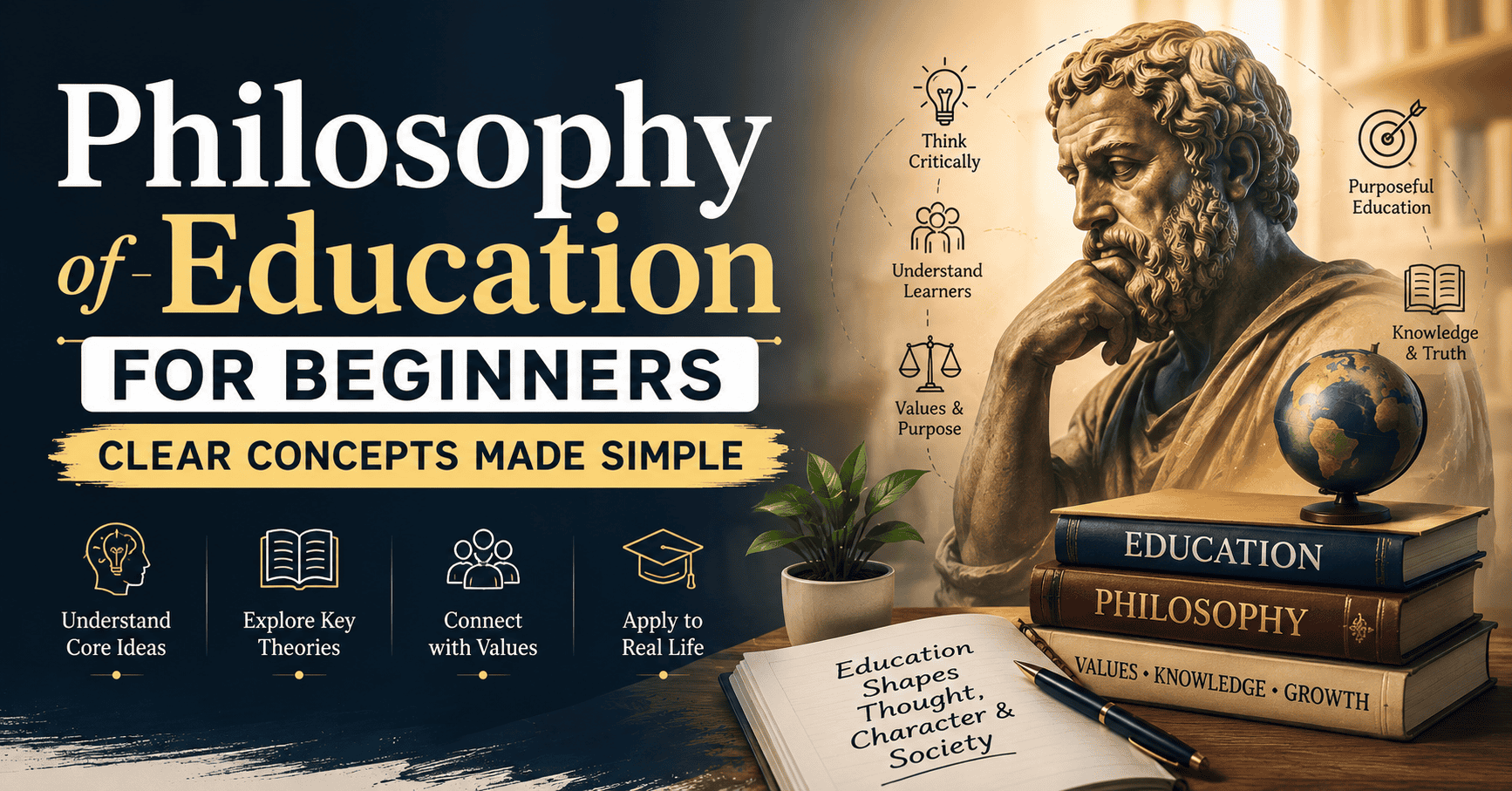
Examine the Purpose, Values, and Goals Behind Education — The Philosophy of Education explores fundamental questions about why education exists, what students should learn, and what schools should aim to accomplish. It considers whether education should primarily provide knowledge and academic skills, develop personal character, encourage independent thinking, prepare individuals for employment, or help them become responsible members of society. Rather than focusing only on teaching methods and curriculum content, this field examines the deeper principles and values that influence educational decisions.
Drawing on ideas from influential thinkers such as Plato, John Dewey, and Paulo Freire, the subject investigates different perspectives on learning, teaching, freedom, discipline, equality, and the role of education in society. It encourages educators and learners to examine the assumptions behind educational practices and consider what kind of individuals and communities those practices are intended to develop. At its core, the Philosophy of Education asks what education should achieve and how learning can contribute to both individual development and society.
Content Overview
- What is Education – Complete Professional Guide
- Philosophy of Education
- Purpose and Objectives of Education
- Importance of Education
- Types of Education
- Structure of Education Systems
- Examination and Assessment Systems
- Key Stakeholders in Education
- Education and Technology
- Practical Task – Design Your Personal Education Philosophy
What is Education – Complete Professional Guide
Education is a systematic, organized, and lifelong process through which individuals acquire knowledge, skills, values, attitudes, and habits that enable intellectual, social, moral, and economic development. Education is the foundation of personal growth and social advancement. It shapes how individuals think, behave, earn, and contribute to their communities. A strong education system develops intellectual ability, moral character, professional skills, and social responsibility.
Example: A child learning reading and writing skills in school is gaining formal education, while learning discipline, teamwork, and communication through sports is also part of education. Even learning to cook from a parent or solving a real‑life budgeting problem are educational experiences.
Education is a comprehensive system involving learners, teachers, parents, governments, philosophies, assessments, and technology. A complete understanding of education helps build informed individuals and progressive societies prepared for future challenges.
Philosophy of Education
The philosophy of education studies the aims, methods, and values of education and how learning should occur. It asks fundamental questions: Why do we educate? What should be taught? How should teaching happen? What is the role of the teacher and the learner?
Applied Philosophy in Education
Educational philosophy influences teaching strategies, curriculum design, moral education, and civic responsibility.
Example: A school that emphasises community service programs is applying the philosophy that education should develop social responsibility and ethics, not just academic knowledge.
Major Philosophical Approaches
| Philosophy | Core Idea | Classroom Application |
|---|---|---|
| Idealism | Education should develop the mind and moral character. Ideas are the only true reality. | Studying great books, philosophy, ethics; emphasis on lecture and discussion. |
| Realism | Knowledge comes from observing the physical world. Science and logic are central. | Teaching science through experimentation, mathematics through problem‑solving. |
| Pragmatism | Learning should be active, experiential, and relevant to real life. Truth is what works. | Project‑based learning, group work, field trips, “learning by doing.” |
| Existentialism | Education should foster individual freedom, creativity, and personal choice. | Student‑selected projects, arts, self‑expression, dialogue over lecturing. |
Example – project‑based learning: Students work together to design a solution for reducing plastic waste in their community. They research, interview experts, prototype, and present. This reflects the pragmatic philosophy because learning happens through real, meaningful activity.
Example – Socratic seminar: A class discusses a moral dilemma from literature. The teacher asks open‑ended questions, and students form their own conclusions. This reflects existentialist and idealist elements – developing the mind and individual values.
Purpose and Objectives of Education
Education serves multiple purposes beyond earning degrees. Its key objectives include:
- Intellectual development – learning to think critically, solve problems, and reason logically.
- Moral training – understanding right from wrong, developing empathy and integrity.
- Economic self‑reliance – acquiring skills and knowledge to earn a living.
- Social responsibility – contributing to community, respecting laws and diversity.
- Lifelong learning – cultivating curiosity and the ability to learn independently.
Example: An educated person not only earns income but also understands civic duties, respects laws, votes thoughtfully, volunteers, and contributes positively to society. Education turns a job holder into a citizen.
Importance of Education
Education is essential for personal empowerment and national development. It promotes:
- Critical thinking – questioning assumptions, evaluating evidence.
- Poverty reduction – education increases employability and income.
- Stronger democracy – informed citizens make better collective decisions.
- Health awareness – educated people make better health choices for themselves and their families.
- Economic growth – a skilled workforce drives innovation and productivity.
Example: Countries with high literacy rates often show lower crime rates, lower infant mortality, higher political participation, and stronger economic stability. For instance, a one‑year increase in average education levels can raise GDP per capita by 3‑6%.
Types of Education
Education is not limited to classrooms. It takes three main forms.
Formal Education
Formal education is structured learning provided by recognised institutions such as schools, colleges, and universities. It follows a prescribed curriculum, examination system, and certification process.
Example: Completing a Bachelor of Science (BSc) degree from a university. The student attends lectures, takes exams, earns credits, and receives a degree upon graduation.
Informal Education
Informal education occurs naturally through daily life experiences, observation, and interaction. It is unstructured and continuous, happening without a formal curriculum or teacher.
Example: Learning problem‑solving skills by fixing a broken bicycle with a friend. Learning negotiation from bargaining at a market. Learning patience from caring for a sick relative. Informal education never stops.
Non‑Formal Education
Non‑formal education consists of organised learning outside the formal system, usually focused on practical skills. It often leads to a certificate but not a full degree.
Example: Attending a vocational training program in graphic design, a community‑based literacy class, or an online coding bootcamp. These are structured but more flexible than formal schooling.
Structure of Education Systems
Education systems are divided into levels according to learners’ developmental stages.
Global Education Frameworks
Different countries follow different frameworks.
| Framework | Characteristics | Example Countries |
|---|---|---|
| British System (O Level / A Level) | Emphasises subject specialisation and academic depth. O Levels (usually at age 16), A Levels (age 18). | UK, Pakistan, Bangladesh, many Commonwealth nations |
| American K–12 System | Broad‑based education from kindergarten to Grade 12. Students take a range of subjects before specialising at university. | USA, Canada, some international schools worldwide |
| International Baccalaureate (IB) | Focuses on inquiry‑based learning, global citizenship, and critical thinking. Includes Primary Years, Middle Years, and Diploma Programme. | International schools globally |
| South Asian Systems (Matric / Intermediate) | Common in Pakistan and India. Matriculation (Grade 10) and Intermediate (Grade 12) with board examinations. | Pakistan, India, Nepal, Bangladesh |
School Education
| Level | Grades | Focus | Example |
|---|---|---|---|
| Primary Education | 1–5 | Basic literacy, numeracy, moral values, social skills | Learning addition and subtraction, reading simple stories, sharing with classmates |
| Middle Education | 6–8 | Introduces subject‑based learning and analytical thinking | Studying basic biology (parts of a flower), world history (ancient civilisations) |
| Secondary Education | 9–12 | Prepares for higher education or careers | Selecting science (physics, chemistry) or humanities (economics, psychology) |
Higher Education (Tertiary)
| Level | Description | Examples |
|---|---|---|
| Undergraduate (Bachelor’s Degree) | Foundational academic and professional education, typically 3‑4 years | BA (Bachelor of Arts), BSc (Bachelor of Science), BEng (Bachelor of Engineering) |
| Postgraduate (Master’s Degree) | Advanced specialisation and professional skills, typically 1‑2 years | MA, MSc, MBA (Master of Business Administration) |
| Doctoral Studies (PhD, EdD) | Research‑oriented highest academic qualification; original research required | PhD in Artificial Intelligence, EdD in Education Policy |
Academic vs. Vocational Education
| Aspect | Academic Education | Vocational Education |
|---|---|---|
| Focus | Theory, research, broad knowledge | Practical, job‑ready skills |
| Outcome | Degrees (BA, BSc, MA, PhD) | Certificates, diplomas, licenses |
| Example | Studying economics, history, mathematics | Training as an electrician, chef, graphic designer |
| Career path | Researcher, teacher, analyst, manager | Technician, craftsman, skilled trade |
Example: A student who studies economics at university (academic) may become a policy analyst. Another student who completes a two‑year vocational program in plumbing earns a certificate and starts a business. Both are educated, but their paths differ.
Examination and Assessment Systems
Examinations evaluate learning outcomes. They can be written, oral, practical, standardised, or continuous.
Grading Systems
GPA System (USA and many universities)
GPA formula:
GPA is calculated by dividing the total grade points by the total number of credit hours.
Example calculation: A student takes three courses:
- Course A: 4.0 grade points × 3 credit hours = 12.0
- Course B: 3.0 grade points × 3 credit hours = 9.0
- Course C: 2.0 grade points × 3 credit hours = 6.0
Total grade points = 12.0 + 9.0 + 6.0 = 27.0
The total number of credit hours is calculated as 3 + 3 + 3, which equals 9.GPA = 27.0 ÷ 9 = 3.0
Result: GPA = 3.0 (B average)
Percentage System (widely used in schools)
Percentage formula:
The percentage is found by dividing the marks obtained by the total marks and then multiplying the result by 100.
Example calculation: A student obtains 450 marks out of a total of 600.
Percentage = (450 ÷ 600) × 100 = 0.75 × 100 = 75%
Result: Percentage = 75%
Key Stakeholders in Education
Education is a collaborative process involving multiple stakeholders who shape learning outcomes.
Role of Teachers
Teachers are the backbone of education. They deliver knowledge, guide thinking, mentor students, and inspire lifelong learning.
Example: A science teacher demonstrating an experiment to clarify abstract concepts (e.g., showing chemical reactions instead of just reading about them). A good teacher also listens, encourages curiosity, and adapts to different learning styles.
Role of Parents
Parents support education by creating a positive learning environment, motivating children, and reinforcing values at home.
Example: Parents helping children with homework, establishing a quiet study space, encouraging reading habits, and attending parent‑teacher meetings. The home environment significantly affects educational outcomes.
Role of Government
Governments oversee, finance, and standardize education in order to maintain quality and promote equal access.
Example: Implementing national curricula, setting teacher certification standards, funding public schools, and conducting standardised examinations (e.g., board exams). Governments also create policies for inclusive education for students with disabilities.
Education and Technology
E‑Learning and Online Education
Digital platforms enable flexible, global, and self‑paced learning. Students can access courses from anywhere, at any time, often at lower cost than traditional education.
Examples: Coursera, edX, Khan Academy, Duolingo. A student in a rural village can take a programming course from a top university.
Role of Artificial Intelligence in Education
AI enables personalised learning, automated grading, virtual classrooms, and adaptive assessments.
Example: An AI system adjusts quiz difficulty based on student performance. If a student answers correctly, the next question becomes harder; if they struggle, the system offers hints or reviews basic concepts. This mimics a human tutor’s responsiveness.
Other AI applications:
- Automated essay scoring (with human oversight)
- Intelligent tutoring systems for maths and languages
- Administrative task automation (scheduling, attendance)
- Predictive analytics to identify at‑risk students
Ethical considerations: AI in education raises questions about data privacy, algorithmic bias, and the role of human teachers. Philosophy of education helps navigate these issues.
Practical Task – Design Your Personal Education Philosophy
Write a one‑page statement answering the following questions:
- What is the purpose of education? (Intellectual growth? Job preparation? Character building?)
- How should students learn? (Through lectures? Projects? Discussion? Real‑world experience?)
- What is the teacher’s role? (Authority? Facilitator? Mentor?)
- What subjects are most important and why? (Science? Arts? Ethics? Life skills?)
- How should learning be assessed? (Exams? Portfolios? Performance tasks?)
After writing your statement, compare it to the four major philosophies (Idealism, Realism, Pragmatism, Existentialism). Which option most closely aligns with your perspective? Which one challenges your view? Discuss with a peer.
Final Summary
Education is a lifelong, systematic process that develops knowledge, skills, values, and habits. It includes formal schooling, informal life experiences, and non‑formal training. Philosophical approaches like idealism, realism, pragmatism, and existentialism shape how we teach and learn. Education serves intellectual, moral, economic, and social purposes. Its importance extends from individual empowerment to national development. Different systems (British, American, IB, South Asian) and levels (primary to doctoral) provide diverse pathways. Assessment methods include GPA and percentage calculations. Stakeholders – teachers, parents, governments – must collaborate. Technology, especially AI, is transforming education through personalisation and automation. A complete understanding of education enables us to build better learners, teachers, and societies.