Philosophy
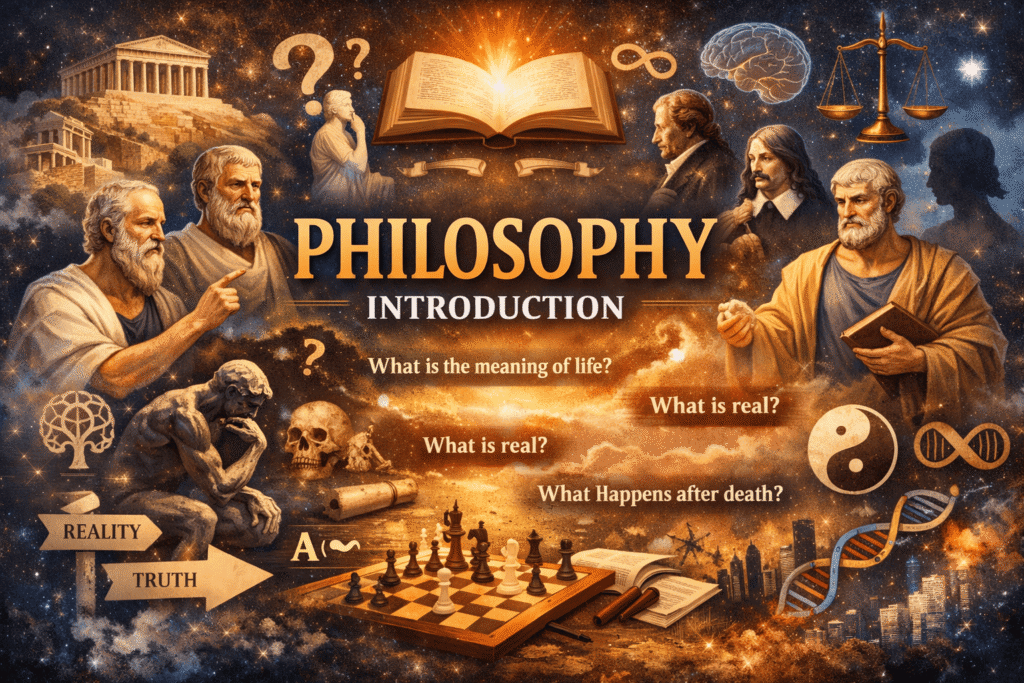
Do you ever catch yourself reflecting on the deeper questions about life? If so, you’re already doing philosophy. People everywhere have always engaged in some form of philosophy. The most significant philosophical ideas began in ancient Greece, where thinkers started asking deep questions about everything around them.
Content Overview
Philosophy Introduction
Philosophy comes from the Ancient Greek words philos (love) and sophia (wisdom) – literally “love of wisdom”. It is the study of fundamental questions about reality, thought, and human experience. Philosophy challenges us to think deeply, question assumptions, and explore concepts that shape our worldview. It looks into topics like existence, reason, knowledge, values, thoughts, and language.
Let’s explore Philosophy (love of wisdom) and how it shapes our understanding of existence, knowledge, and the human condition. Philosophy invites everyone, whether you are new to it or have some experience, to explore its key aspects, historical roots, and the profound questions it seeks to answer.
It’s a journey of questioning, understanding, and critical thinking, where you use your mind to explore life’s most perplexing mysteries and find the answers that resonate with us. So, let’s embark on this journey together and dive into the fascinating world of philosophy.
Unlike other subjects that provide facts, philosophy teaches us how to ask better questions – and sometimes, the questions matter more than the answers.
The Roots of Philosophy
Philosophy began in Ancient Greece around 500 BCE when people started to separate logos (reason and science) from mythos (storytelling and myths). Philosophy is not just an academic subject; it is a way of thinking about the world, existence, and our place in it. It examines questions like:
- What is truth?
- What is the meaning of life?
- How should we live?
Example: When you wake up in the morning and decide what to do, you might not realise that you are already doing philosophy. You ask yourself: “Should I go to work or stay home?” That is a practical question. But philosophy asks a deeper layer: “Why should I work at all?” Or you might wonder what truly makes a day feel meaningful and worthwhile.These questions have no single correct answer, but thinking about them changes how you live.
Methods of Philosophy
Philosophy does not conduct experiments like science, but it has unique methods of inquiry:
| Method | Description | Example |
|---|---|---|
| Logical Analysis | Breaking arguments into premises and conclusions to test validity | All humans are mortal. Socrates is human. Therefore, Socrates is mortal. |
| Thought Experiments | Imagining scenarios to test moral or metaphysical ideas | “The Trolley Problem”: a runaway trolley is heading toward five people tied to the track. You can pull a lever to divert it onto a side track where one person is tied. Should you pull the lever? This explores whether it is ethical to sacrifice one to save many. |
| Dialectic (Socratic questioning) | Engaging in dialogue to refine ideas by asking “why?” repeatedly | A person says “I want to be happy.” Socrates asks “What is happiness?” The person answers “Feeling good.” Socrates asks “What is ‘feeling good’?”This process goes on until the individual recognizes that their understanding of the concept is incomplete. |
| Conceptual Analysis | Examining the meanings of words and ideas to clarify philosophical concepts | What does “knowledge” really mean? Is it just true belief, or must it also be justified? |
Example of logical thinking (syllogism):
Premise 1: All humans are mortal.
Premise 2: Socrates is human.
Conclusion: Therefore, Socrates is mortal.
This argument is valid because if the premises are true, the conclusion must be true. Philosophy trains the mind to recognise such patterns and spot logical fallacies.
Spread of Greek Philosophy
Greek ideas spread far and wide after Alexander the Great conquered many lands. The Romans adopted these ideas, and later, early Christians used Greek philosophy to help explain their beliefs. For example, the idea of Logos, understood as divine reason in Greek philosophy, was later integrated into Christian theological thought.
Example: When you hear phrases like “the nature of reality” or “the pursuit of wisdom,” you are seeing echoes of Greek philosophy in modern language, science, and even law.
Modern & Contemporary Philosophy
Modern and contemporary philosophy explores consciousness, ethics, and language. As Ludwig Wittgenstein famously said: “The limits of my language mean the limits of my world.”
Philosophy has changed over time, with each period adding to or questioning previous ideas:
- Ancient Philosophy: Plato, Aristotle, Socrates – laid the foundation for Western thought.
- Medieval Philosophy: St. Augustine, Thomas Aquinas – blended theology with philosophy.
- Modern Philosophy (17th‑19th centuries): Descartes, Kant, Hegel – emphasised reason, the self, and historical progress.
- Contemporary Philosophy (20th‑21st centuries): Existentialism, analytic philosophy, postmodernism – questioned absolute truth and focused on language, existence, and power.
Example: Modern philosophy asks not only “What is reality?” but also “How does language shape what we can even say about reality?” Wittgenstein’s statement means that if you have no word for a concept (like “tomorrow” in some languages), it becomes harder to think about the future. Words are not just tools; they shape thought.
The Big Questions & Early Thinkers
What’s Everything Made Of? (Pre‑Socratic Views)
The question “What’s everything made of?” fascinated early philosophers. Each proposed a different fundamental substance:
| Philosopher | Fundamental Substance | Reasoning |
|---|---|---|
| Thales | Water | Water is vital for sustaining life and can be found in several states, including liquid, solid, and gas. |
| Heraclitus | Fire | Fire is always moving and changing, representing the constant flux of the world. You can never enter the same river in exactly the same way twice. |
| Empedocles | Four elements (water, fire, earth, air) | Combined and separated by love (attraction) and strife (repulsion). |
| Democritus | Atoms (indivisible particles) | Tiny particles moving through the void, combining to form all matter. |
| Pythagoras | Numbers | Mathematical patterns underlie all of nature – the harmony of music, the orbits of planets. |
| Anaximenes | Air | Everything is formed through condensation (thicker) and rarefaction (thinner) of air. |
| Parmenides | Change is an illusion | Reality is unchanging and indivisible; the sensory world is deceptive. Only reason can lead to truth. |
Example: Imagine you are looking at a table. A materialist (like Democritus) says it is really a cloud of atoms. A Pythagorean says the table’s reality lies in the mathematical ratios that make it stable. A Parmenidean says the table only appears to change; in true reality, nothing ever changes. These are not just ancient curiosities – they directly anticipate modern physics (atoms), mathematics (mathematical realism), and even block‑universe theory.
Socrates & His Method
Socrates, one of the founders of Western philosophy, used a method of questioning (the Socratic Method) to encourage critical thinking. He asked deep, probing questions to challenge assumptions and explore ethical concepts.
Example of Socratic questioning in daily life:
Socrates asks: “What are you doing?”
Person: “I’m going to the store.”
Socrates: “Why?”
Person: “I need food.”
Socrates: “Why?”
Person: “I’m hungry.”
Socrates: “Why?”
Person: “My body needs food to live.”
Socrates: “Why?”
Person: “Because being alive is good.”
Socrates: “Why?”
Person: “Because life has value.”
Socrates: “Why?”
Person: “Because it makes me happy.”
Socrates: “What is happiness?”
The process continues. Socrates’ persistent questioning eventually led to his execution.He is well known for stating that a life lived without reflection or inquiry lacks true value.
Practical takeaway: The next time you hold a strong opinion, ask yourself “Why?” five times. You will often discover that your belief rests on an assumption you have never examined.
Plato’s Theory of Forms
Plato, a student of Socrates, believed in a world of forms – abstract ideas more real than physical objects. He introduced the theory of forms: everything in the physical world is merely a shadow or imperfect copy of its ideal version. He illustrated this in the Allegory of the Cave.
Allegory of the Cave (simplified): Prisoners are chained inside a cave, facing a wall. Behind them, a fire casts shadows of puppets on the wall. The captives take the shadows to be genuine reality. One prisoner escapes, sees the actual puppets, then leaves the cave and sees the real world – trees, sun, sky. He comes to understand that the shadows were only imitations. When he returns to tell the others, they do not believe him and threaten to kill him.
Example: The idea of an apple (its perfect “form”) exists in the world of forms and is more real than any physical apple you can see. Every actual apple is an imperfect copy of the Form of Apple. Similarly, the Form of Justice exists perfectly, even though human laws are only imperfect attempts at justice.
Aristotle’s View & Four Causes
Aristotle, Plato’s student, disagreed with Plato’s separation of ideas and objects. He focused on observing things and using clear reasoning. He believed the form of an object exists within the object itself. He put forward the idea of the Four Causes to explain the reasons behind why things exist and function as they do:3
| Cause | Question | Example (statue) |
|---|---|---|
| Material | What is it made of? | Marble |
| Formal | What shape or form does it have? | The design of the statue |
| Efficient | What brought it into being? | The sculptor |
| Final | What is its purpose? | Decoration or honour |
Example – a house:
- Material cause: bricks, wood, glass.
- Formal cause: the architectural blueprint.
- Efficient cause: the construction workers.
- Final cause: to provide shelter.
Aristotle also believed that God is the Unmoved Mover – the first cause that causes all other things without being caused itself. Unlike Plato, Aristotle thought we could understand forms by studying physical objects around us.
Enlightenment & the Evolution of Truth
The Enlightenment (or Age of Reason, 17th‑18th centuries) emphasised reason, science, and questioning traditional beliefs. Key ideas included rationalism (knowledge through reasoning), empiricism (knowledge through sensory experience), and human rights (individual freedoms). Immanuel Kant’s motto: “Dare to know!”
Georg Wilhelm Friedrich Hegel believed that truth gets better over time – that history moves toward greater freedom and self‑awareness. He called this the dialectic: a thesis encounters an antithesis, and their conflict produces a synthesis, which becomes the new thesis. Progress happens through this clash of opposites.
Example: Think of technology. Early phones (thesis) were big and wired. Mobile phones (antithesis) freed people. Smartphones (synthesis) combined portability with computing power. Each stage is better than the last. Hegel applied this to ideas, history, and society.
However, the major tragedies of the 20th century (two World Wars, the Holocaust) made this idea of endless progress seem uncertain. Even as technology advanced, human suffering persisted. Philosophers after Hegel became more cautious about claiming that history always moves toward improvement.
Key Areas (Branches) of Philosophy
Philosophy is divided into several major branches, each exploring a different dimension of human experience.
Epistemology – Study of Knowledge
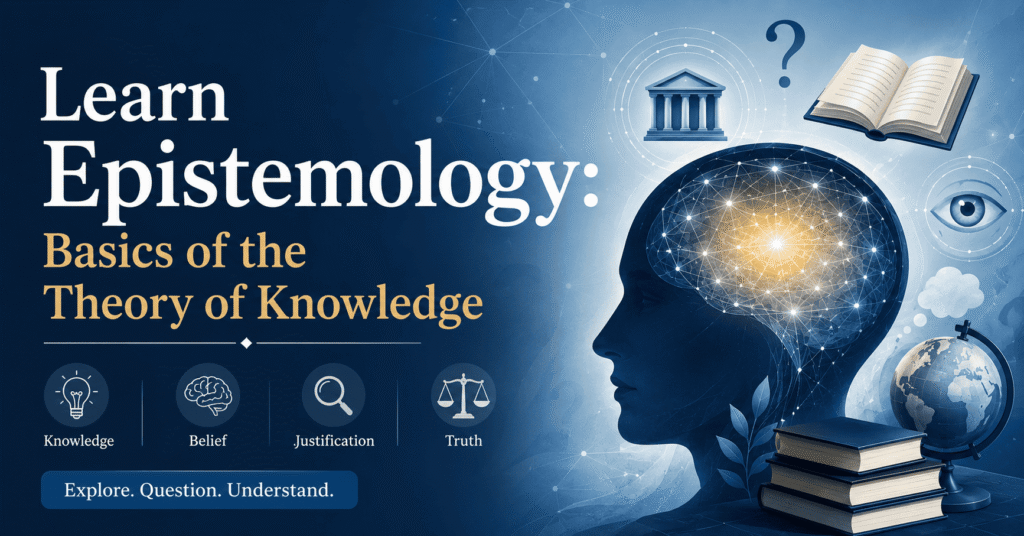
Epistemology examines what knowledge is, how it is acquired, and how we can be sure that what we know is true.
Key questions:
- How does belief differ from knowledge?
- Can we ever be certain?
- Is knowledge possible, or are we always trapped in our own perceptions?
Example: You say “I know the sky is blue.” How do you know? Is it because you have seen it? But colour is a perception – a person with colour blindness sees it differently. Is it because scientists say so? But science can be wrong. Epistemology asks: what would count as justified true belief? This branch helps us distinguish between opinion, faith, and knowledge.
Metaphysics – Study of Reality
Metaphysics explores what is real, what exists, and the nature of being.
Key questions:
- Is time real or an illusion?
- Do abstract concepts (like numbers) exist independently?
- What is the nature of existence?
Example: When you look at a chair, is the chair “real” or is it just a collection of atoms in a certain arrangement? Metaphysics asks whether the chair’s “chairness” exists beyond the physical matter. Some metaphysicians argue that only atoms are real (materialism), while others argue that the form or idea of the chair is equally real (idealism).
Ethics – Study of Morality
Ethics studies morality and human behaviour, asking what is right and wrong, good and bad, and how we should live.
Key questions:
- Are right and wrong universal, or do they depend on culture?
- Should we act based on rules (deontology) or consequences (utilitarianism)?
- What is the good life?
Example: Is it right to lie to spare someone’s feelings? A deontologist (rule‑based) says lying is always wrong, no matter the outcome. A utilitarian (consequence‑based) says it is right if it produces more happiness than sadness. This debate has real implications for medical ethics, business, and personal relationships.
Aesthetics – Study of Beauty & Art
Aesthetics explores beauty, art, and taste.
Key questions:
- What makes something beautiful?
- Is beauty subjective or objective?
- What is the purpose of art?
Example: Why do some people find a modern painting beautiful while others call it a mess? Aesthetics examines whether there are universal standards of beauty (e.g., symmetry, proportion) or whether beauty is entirely in the eye of the beholder. This branch also asks whether art must be morally good to be artistically good.
Political Philosophy, Philosophy of Mind & Language
| Branch | Focus | Example Question |
|---|---|---|
| Political Philosophy | Government, justice, rights | “What is the best type of government?” (Democracy? Monarchy? Anarchism?) |
| Philosophy of Mind | Consciousness, mental states | “Is the mind separate from the brain, or is consciousness just brain activity?” |
| Philosophy of Language | Meaning, reference, communication | “How do words acquire meaning? By pointing to objects, or by their use in a community?” |
Example – Philosophy of Mind: When you feel pain, is that feeling just a pattern of neurons firing? If you scan a brain, you see electrical signals. But you do not see the feeling of pain. The “hard problem of consciousness” asks why and how physical processes produce subjective experience.
Logic – Study of Valid Reasoning
Logic focuses on valid reasoning and argumentation. It provides the rules for distinguishing good arguments from bad ones, regardless of the subject matter.
Example of deductive reasoning:
When rain falls, the ground becomes wet.
It is raining.
Therefore, the ground is wet.
This is valid because the conclusion follows necessarily from the premises. Logic also studies fallacies – errors in reasoning that make arguments unsound even if the conclusion happens to be true.
Example of a fallacy (ad hominem): “You claim that we should eat less sugar, but you are overweight, so your argument is wrong.” Attacking the person instead of the argument is a logical fallacy.
Schools of Thought & Theories
Philosophy includes various schools of thought (idealism, materialism, existentialism, pragmatism, etc.) and theories (determinism, dualism, deontology) that provide different perspectives.
Existentialism, Empiricism, Materialism
| School | Key Idea | Example |
|---|---|---|
| Existentialism | Life has no inherent meaning; we create our own purpose through our choices. | If you have felt lost and wondered “What’s the point?”, existentialism says you are the one who must decide the answer. Jean‑Paul Sartre said “Existence precedes essence” – you are born without a pre‑defined purpose, and then you become what you make of yourself. |
| Empiricism | All knowledge comes from sensory experience. | Scientists conduct experiments and observe results – that is empiricism in action. John Locke compared the mind to a tabula rasa (blank slate) that is filled only by experience. |
| Materialism | Everything, including thoughts and emotions, is made of physical matter. | If you believe the brain produces thoughts (not a “soul”), you are thinking like a materialist. Karl Marx extended materialism to history: economic conditions (matter) shape ideas and culture, not the other way around. |
Phenomenology, Humanism, Nihilism
| School | Key Idea | Example |
|---|---|---|
| Phenomenology | Reality is shaped by our perceptions and experiences from a first‑person perspective. | Two people can witness the same car accident. One focuses on the sound, the other on the colour of the cars. Their lived experiences differ. Phenomenology studies these structures of experience, not the objective world. |
| Humanism | Humans have the power to solve problems and improve the world through reason and compassion. | Working to end poverty, promote education, or fight disease – humanism trusts human potential without relying on divine intervention. |
| Nihilism | Life has no objective meaning, purpose, or intrinsic value. | Sometimes expressed as “nothing matters.” Friedrich Nietzsche warned that nihilism could arise when traditional religious and moral beliefs lose their power. But he also saw it as an opportunity to create new values. |
Determinism, Dualism, Deontology
| Theory | Key Idea | Example |
|---|---|---|
| Determinism | Every event is caused by previous events; free will is an illusion. | If you decide to eat pizza instead of a salad, was that really your choice? A determinist would say your genes (taste for fat), upbringing (family eating habits), and environment (what food was available) made that decision inevitable. You just feel like you chose freely. |
| Dualism | The mind and the body exist as two distinct and separate entities.. | Believing in a soul that exists beyond your physical body is dualism. René Descartes famously said “I think, therefore I am” – he concluded that the mind (thinking substance) is fundamentally different from the body (extended substance). |
| Deontology | Actions are right or wrong based on rules or duties, not consequences. | Lying is always wrong, even if it saves someone’s feelings or even a life. Immanuel Kant argued that we should act only according to maxims that could become universal laws – the categorical imperative. |
Meta‑Philosophy & Importance
What is Meta‑Philosophy?
Meta‑philosophy (or philosophy of philosophy) studies the nature, aims, and methods of philosophy itself. It asks questions like:
- What is philosophy?
- What is the goal of philosophy? Should it be practical (helping us live better) or purely theoretical (seeking truth for its own sake)?
- Is philosophy still relevant in the age of science and technology?
Example: A scientist might ask “How does the brain produce consciousness?” A meta‑philosopher asks “What kind of question is that? Can science ever answer it, or is it a philosophical question?” Meta‑philosophy reflects on the discipline’s own methods, ensuring that philosophy does not become dogmatic or irrelevant.
Philosophy vs Other Subjects
| Feature | Philosophy | Science |
|---|---|---|
| Method | Logical analysis, thought experiments, dialectic | Observation, experimentation, measurement |
| Answers | Often no absolute answers; focuses on questions | Provisional, testable, falsifiable answers |
| Relationship | Asks why facts matter and what they imply | Provides empirical facts |
Example: Physics asks how the universe works (through equations and experiments). Philosophy asks why the universe exists at all. Psychology studies human behaviour (through surveys and brain scans). Philosophy explores the nature of consciousness and the self – questions that empirical methods alone cannot settle.
Why Philosophy? Aims & Key Questions
Why philosophy matters:
- It encourages critical thinking and questioning.
- It enables us to make sense of the world and our role within it.
- It provides tools to analyse ethical, political, and scientific issues.
- It connects diverse fields of knowledge, fostering interdisciplinary understanding.
Aims of philosophy:
- To seek truth – about existence, morality, and knowledge.
- To promote critical thinking – question assumptions, think logically.
- To understand the human condition – reflect on life’s meaning, ethics, and human nature.
- To build a just society – provide theoretical foundations for justice, democracy, and governance.
Key questions that philosophy continues to ask – with deeper examples:
What is the meaning of life?
Are we here for a purpose, or do we create our own meaning? If you have ever wondered “Why am I here?” or “What is the ultimate purpose behind everything?” – you are asking a philosophical question. Some say the meaning is to be happy; others say it is to serve God; existentialists say there is no meaning except what you make. Even asking the question changes how you live.
What happens after death?
Do we cease to exist, or does consciousness continue? Different religions offer different answers, but philosophy asks: “Is there any way to know?” This question influences how we value life, how we grieve, and how we make choices about the end of life.
What is beauty?
Why do some people find a sunset beautiful while others might not? Is beauty in the object (symmetry, colour) or in the eye of the beholder? Art critics, advertisers, and even AI image generators rely on philosophical assumptions about beauty.
What is real?
Is the world as we see it truly real, or could we be in a simulation (like The Matrix)? If you cannot prove that you are not dreaming, how can you be sure of anything? This question leads to deep skepticism and also to new sciences like virtual reality.
What is right and wrong (morality)?
Are there universal moral truths, or does morality depend on culture? If a culture practices slavery, is that wrong regardless of what the culture believes? Philosophers debate whether morality is discovered (like mathematics) or invented (like fashion).
How can we understand what we truly know?
If you claim, “I know the sky is blue,” what is that knowledge based on? Is it simply because you’ve observed it? But your eyes can be fooled. Is it because scientists say so? But science changes. Epistemology asks: what is the difference between thinking you know and actually knowing?
Do we have free will?
Do we have free will, or is everything in life already decided for us? Are our choices our own, or are they determined by factors beyond our control? This question asks whether we are truly free to make our own choices or if everything is predetermined.
Example: If you decide to eat pizza instead of a salad, was that really your choice, or was it influenced by your genes (craving fat), your upbringing (what you were fed as a child), your environment (what the cafeteria serves), and even advertising? A determinist would say that given all those causes, you could not have chosen differently. A libertarian (free will advocate) would say that you could have chosen the salad if you had wanted to, regardless of the influences. The answer affects how we praise, blame, punish, and reward each other.
Final Summary
Philosophy, often described as the pursuit or love of wisdom, is a field that explores fundamental questions about reality, knowledge, morality, beauty, politics, and the nature of the mind. It began in Ancient Greece with thinkers like Socrates, Plato, and Aristotle, and has evolved through the Enlightenment to modern and contemporary philosophy. Philosophy uses methods like logical analysis, thought experiments, and dialectic (Socratic questioning). Its main areas include epistemology, metaphysics, ethics, aesthetics, political philosophy, the philosophy of mind and language, as well as logic.. Schools of thought such as existentialism, empiricism, materialism, and theories like determinism, dualism, and deontology provide diverse frameworks for answering life’s biggest questions. Meta‑philosophy reflects on philosophy’s own purpose. Ultimately, philosophy is not about finding fixed answers but about learning to ask better questions – a never‑ending quest for wisdom that remains essential for critical thinking, ethical living, and understanding our place in the world.
Practical final task – write your own philosophical reflection.
Choose one of the key questions (e.g., “Do I have free will?” or “What makes an action right or wrong?”). Write one page giving your reasoned opinion. Then, find someone with an opposite view and discuss it respectfully. The goal is not to win but to understand why someone else sees the world differently. That is philosophy in practice.
Stay curious, keep questioning, and embrace the journey of wisdom.