Crash Course · Beginner → Advanced
Project Management: Waterfall, Agile and Scrum Crash Course
Learn the project life cycle, the triple constraint, Waterfall vs Agile, how Scrum and Kanban run, and the planning maths every project manager is asked about — WBS, critical path, PERT and earned value.
Beginner → Advanced17 min readInterview Q&A
- In One Line
- The Triple Constraint
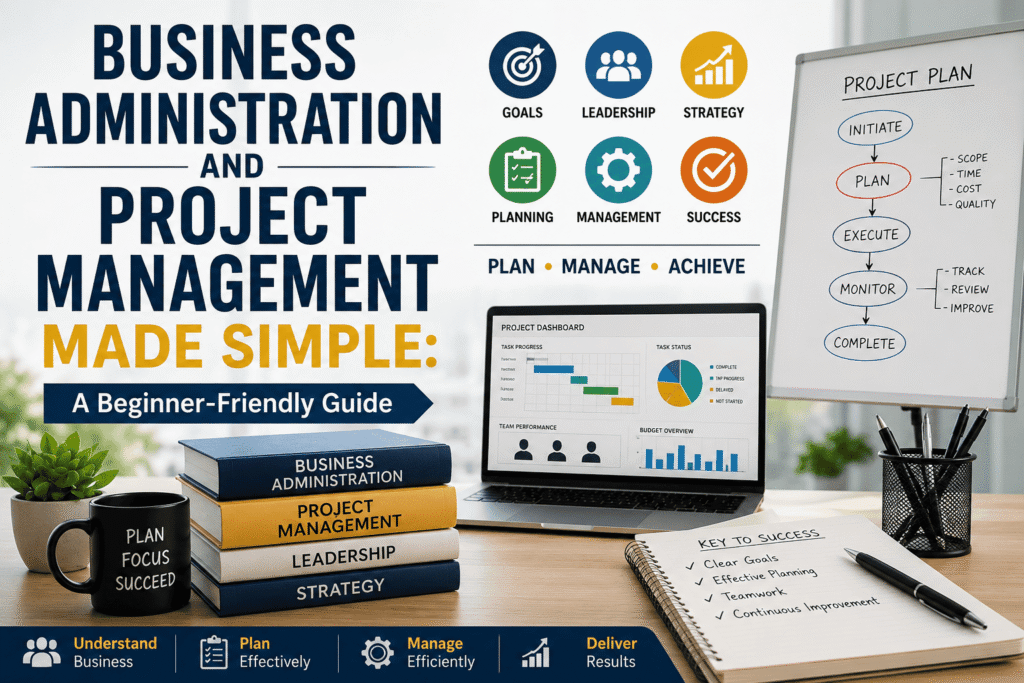
- The Project Life Cycle
- Work Breakdown Structure (WBS)
- Waterfall vs Agile
- The Agile Manifesto in Plain Words
- Scrum: Roles, Events and Artifacts
- Kanban
- Critical Path Method (CPM)
- PERT Three-Point Estimating
- Earned Value Management (EVM)
- Risk Management
- Stakeholders and Communication
- Key Takeaways
- Interview Questions
- Exam Quick Revision
- Continue the Business Administration Path
In One Line
Running the payroll every month is an operation (repeated); building a new payroll system is a project (temporary and unique).
The Triple Constraint
Every project balances three constraints, with quality in the middle:
- Scope — what will be delivered.
- Time — the schedule and deadline.
- Cost — the budget and resources.
Change one and at least one other moves. A client who adds features (scope) must accept more time or more cost — or quality will suffer. Uncontrolled growth of scope is called scope creep.
The Project Life Cycle
| Phase | Key outputs |
|---|---|
| Initiating | Business case, project charter, stakeholders identified. |
| Planning | Scope statement, WBS, schedule, budget, risk and communication plans. |
| Executing | The team builds the deliverables. |
| Monitoring & controlling | Track progress (EVM), manage changes and risks — runs alongside execution. |
| Closing | Hand-over, sign-off, lessons learned, release the team. |
Work Breakdown Structure (WBS)
Example — company website: 1. Design (wireframes, visual design) · 2. Content (copy, images) · 3. Development (front end, back end, CMS) · 4. Testing (functional, mobile, speed) · 5. Launch (domain, go-live, training).
100% rule: the WBS includes all the work — and nothing outside the scope.
Waterfall vs Agile
| Waterfall (predictive) | Agile (adaptive) | |
|---|---|---|
| Flow | Sequential: requirements → design → build → test → deploy | Short iterations that each deliver working value |
| Requirements | Fixed early | Expected to change |
| Customer involvement | Mainly start and end | Continuous |
| Best for | Construction, regulated work, clear stable scope | Software, new products, uncertain requirements |
| Main risk | Late discovery of wrong requirements | Scope drift without strong prioritisation |
Many organisations use a hybrid: a fixed plan for milestones and budget, Agile delivery inside.
The Agile Manifesto in Plain Words
The 2001 Agile Manifesto values the items on the left more than those on the right (both still matter):
- Individuals and interactions over processes and tools.
- Working software over comprehensive documentation.
- Customer collaboration over contract negotiation.
- Responding to change over following a plan.
Scrum: Roles, Events and Artifacts
| Part | What it is |
|---|---|
| Product Owner | Owns the product backlog and maximises value — decides what and in what order. |
| Scrum Master | Coaches the team in Scrum and removes impediments. |
| Developers | Cross-functional people who decide how to build the increment. |
| Sprint | Fixed time-box of one month or less (often 2 weeks). |
| Sprint Planning | Choose the sprint goal and backlog items. |
| Daily Scrum | 15-minute daily sync on progress toward the sprint goal. |
| Sprint Review | Show the increment to stakeholders, adapt the backlog. |
| Retrospective | Improve how the team works. |
| Artifacts | Product Backlog, Sprint Backlog, Increment (meeting the Definition of Done). |
A user story describes a need from the user’s view: “As a customer, I want to save my cart so that I can buy later.” Teams often estimate stories in story points and track velocity (points completed per sprint).
Kanban
- Visualise work on a board: To do → In progress → Review → Done.
- Limit work in progress (WIP) — e.g. maximum 3 cards in “In progress”, so work finishes instead of piling up.
- Measure flow — lead time (request to done) and cycle time (start to done).
Kanban has no fixed sprints or roles, which suits support teams and continuous work.
Critical Path Method (CPM)
The critical path is the longest chain of dependent tasks; it sets the shortest possible project duration. Delay any critical task and the whole project is late.
| Task | Duration | Depends on |
|---|---|---|
| A | 3 days | — |
| B | 5 days | A |
| C | 2 days | A |
| D | 4 days | B and C |
- Path A → B → D = 3 + 5 + 4 = 12 days (critical path).
- Path A → C → D = 3 + 2 + 4 = 9 days.
- Float of C = 12 − 9 = 3 days: C can slip 3 days without delaying the project.
PERT Three-Point Estimating
| O | Optimistic duration — everything goes well. |
| M | Most likely duration. |
| P | Pessimistic duration — many problems. |
| E | Expected (weighted average) duration. |
| σ | Standard deviation — the uncertainty of the estimate. |
Example: O = 4, M = 6, P = 14 days → E = (4 + 24 + 14) ÷ 6 = 42 ÷ 6 = 7 days; σ = (14 − 4) ÷ 6 ≈ 1.67 days.
Earned Value Management (EVM)
| BAC | Budget at completion — the total approved budget. |
| PV | Planned value — budgeted cost of work planned by now. |
| EV | Earned value — budgeted cost of work actually done. |
| AC | Actual cost spent so far. |
| CPI / SPI | Below 1 = over budget / behind schedule; above 1 = under budget / ahead. |
| EAC | Estimate at completion if current cost efficiency continues. |
Example: BAC = 100,000. By now 50% should be done (PV = 50,000), but only 40% is done (EV = 40,000) and 45,000 has been spent (AC).
- CV = 40,000 − 45,000 = −5,000 (over budget)
- SV = 40,000 − 50,000 = −10,000 (behind schedule)
- CPI = 40,000 ÷ 45,000 = 0.89; SPI = 40,000 ÷ 50,000 = 0.80
- EAC = 100,000 ÷ 0.889 ≈ 112,500 — expected final cost.
Risk Management
A risk is an uncertain event that could affect the project. Keep a risk register with each risk, its probability (P), impact (I), score = P × I, owner and response.
| Response (threats) | Example |
|---|---|
| Avoid | Remove a risky feature from scope. |
| Mitigate | Add testing to reduce the chance of defects. |
| Transfer | Insurance, or a fixed-price contract with a supplier. |
| Accept | Small risks — keep a contingency reserve. |
Stakeholders and Communication
- Power/interest grid: manage closely (high power, high interest), keep satisfied (high power, low interest), keep informed (low power, high interest), monitor (low, low).
- RACI chart: for each task — who is Responsible (does it), Accountable (one final owner), Consulted and Informed.
Key Takeaways
- Project = temporary + unique; operations repeat.
- Scope, time and cost trade off; protect quality.
- WBS breaks scope into work packages (100% rule).
- Waterfall for stable scope; Agile/Scrum for changing scope.
- Critical path = longest dependent chain; float = slack.
- EVM: CPI and SPI below 1 signal trouble.
Interview Questions
What is the difference between a project and operations?
A project is temporary and creates something unique; operations are ongoing, repeated activities that keep the business running.
Explain the triple constraint.
Scope, time and cost are linked; changing one affects at least one of the others, and quality depends on the balance.
When would you choose Waterfall over Agile?
When requirements are clear and stable, changes are expensive, or regulation requires full upfront design — e.g. construction or compliance projects.
What are the Scrum roles?
Product Owner (what and priority), Scrum Master (process and impediments), and Developers (how to build the increment).
What is the critical path?
The longest sequence of dependent tasks; it determines the minimum project duration, and its tasks have zero float.
Calculate CPI and SPI: EV 40k, AC 45k, PV 50k.
CPI = 40/45 ≈ 0.89 (over budget); SPI = 40/50 = 0.80 (behind schedule).
How do you handle scope creep?
Use a clear baseline and change-control process: assess each request’s impact on time, cost and risk, get approval, then update the plan.
What is a RACI matrix?
A chart showing who is Responsible, Accountable, Consulted and Informed for each task, with exactly one Accountable person.
Exam Quick Revision
- Project = temporary + unique.
- Triple constraint: scope, time, cost (+ quality).
- Life cycle: initiate, plan, execute, monitor & control, close.
- WBS → work packages; 100% rule.
- Scrum: PO, SM, Developers; sprint, planning, daily, review, retro.
- Kanban: visualise, limit WIP, manage flow.
- PERT: E = (O + 4M + P)/6.
- EVM: CV = EV − AC, SV = EV − PV, CPI = EV/AC, SPI = EV/PV, EAC = BAC/CPI.