Crash Course · Beginner → Advanced
Lesson 1: Accounting Elements and the Accounting Equation
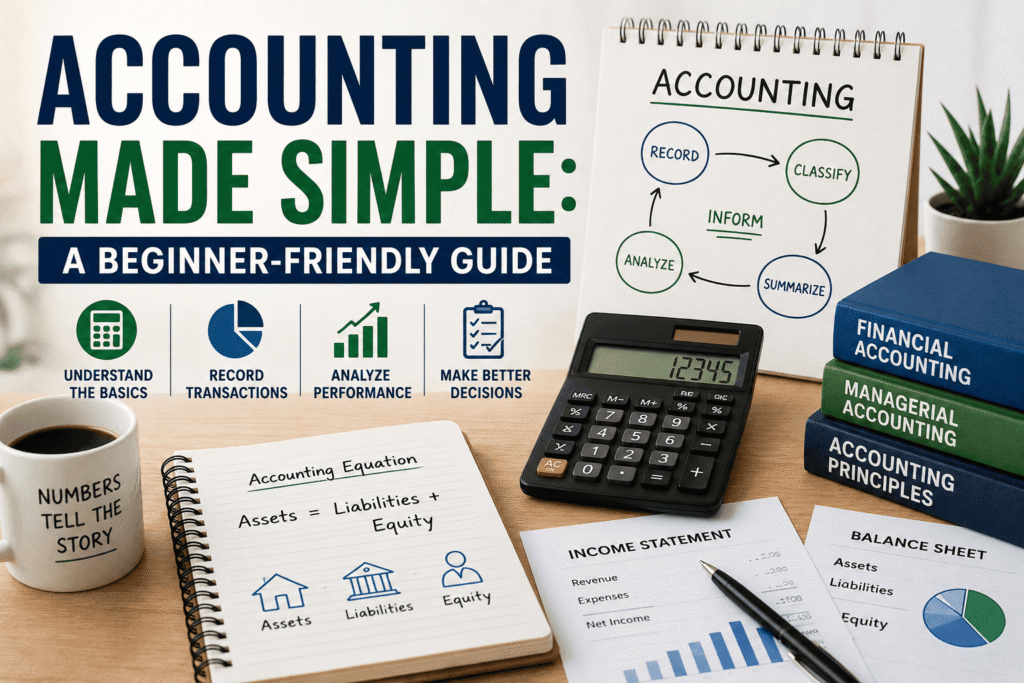
Start the complete accounting cycle with one running example — Bright Bakery’s first month. Learn the five accounting elements (assets, liabilities, equity, income and expenses), the types of business entities, the accounting equation, and analyse all 11 transactions to see the equation stay in balance.
Beginner → Advanced12 min readInterview Q&A
- Course Path: The Accounting Cycle in 6 Lessons
- The Example: Bright Bakery’s First Month
- The Business Entity Concept and Entity Types
- The Five Accounting Elements
- Current vs Non-Current
- The Accounting Equation
- Transaction Analysis: Bright Bakery
- Key Takeaways
- Interview Questions
- Exam Quick Revision
- Continue Learning
Course Path: The Accounting Cycle in 6 Lessons
Every lesson uses the same business so you can follow each number from transaction to financial statements.
- Lesson 1 Elements & Equation (this page)
- Lesson 2 Journal Entries
- Lesson 3 General Ledger
- Lesson 4 Trial Balance
- Lesson 5 Adjusting Entries
- Lesson 6 Financial Statements & Closing
The Example: Bright Bakery’s First Month
Bright Bakery is a new bakery owned by Sara (a sole proprietorship). These are its transactions for January:
| # | Date | Transaction (Bright Bakery, January) |
|---|---|---|
| T1 | Jan 1 | Sara, the owner, invests 50,000 cash in the business. |
| T2 | Jan 2 | Buys an oven (equipment) for 24,000: pays 12,000 cash, owes 12,000 to the supplier. |
| T3 | Jan 3 | Pays 6 months’ rent in advance, 6,000. |
| T4 | Jan 5 | Buys baking supplies on credit, 4,000. |
| T5 | Jan 10 | Cash sales of cakes, 15,000. |
| T6 | Jan 15 | Sells cakes on credit to a café, 5,000. |
| T7 | Jan 20 | Pays suppliers 8,000 (4,000 for supplies + 4,000 towards the oven). |
| T8 | Jan 25 | Receives 3,000 from the café. |
| T9 | Jan 31 | Pays staff wages, 4,500. |
| T10 | Jan 31 | Pays the electricity bill, 800. |
| T11 | Jan 31 | Sara withdraws 2,000 for personal use. |
The Business Entity Concept and Entity Types
The business entity concept says the business’s records are kept separate from the owner’s personal affairs. Sara’s home rent is not a bakery expense; when she takes money out (T11) it is recorded as drawings.
| Entity type | Ownership | Equity accounts |
|---|---|---|
| Sole proprietorship | One owner, unlimited liability | Capital, Drawings |
| Partnership | Two or more partners | Each partner’s capital and drawings |
| Company / corporation | Shareholders, limited liability | Share capital, retained earnings, dividends |
The Five Accounting Elements
| Element | Meaning | Bright Bakery examples |
|---|---|---|
| Assets | Resources the business controls that bring future benefit | Cash, accounts receivable (café owes), supplies, prepaid rent, oven |
| Liabilities | Amounts the business owes to others | Accounts payable (owed to oven supplier), wages payable |
| Equity | Owner’s claim = assets − liabilities | Sara’s capital, minus drawings, plus profit |
| Income (revenue) | Increases in equity from business activities | Cake sales |
| Expenses | Costs used up to earn income | Wages, electricity, rent used, supplies used, depreciation |
Current vs Non-Current
- Current assets — cash or used within 12 months: cash, receivables, supplies, prepaid rent, inventory.
- Non-current (fixed) assets — used for more than a year: oven, vehicles, buildings.
- Current liabilities — due within 12 months: accounts payable, wages payable, short-term loans.
- Non-current liabilities — due later: long-term bank loans.
The Accounting Equation
| Expanded | Assets = Liabilities + Capital − Drawings + Income − Expenses |
Every transaction changes at least two items so the equation always balances. This is the foundation of double-entry bookkeeping.
Transaction Analysis: Bright Bakery
| # | Effect | Assets | Liabilities | Equity |
|---|---|---|---|---|
| T1 | Cash +50,000; Capital +50,000 | 50,000 | 0 | 50,000 |
| T2 | Equipment +24,000; Cash −12,000; Payable +12,000 | 62,000 | 12,000 | 50,000 |
| T3 | Prepaid rent +6,000; Cash −6,000 | 62,000 | 12,000 | 50,000 |
| T4 | Supplies +4,000; Payable +4,000 | 66,000 | 16,000 | 50,000 |
| T5 | Cash +15,000; Revenue +15,000 | 81,000 | 16,000 | 65,000 |
| T6 | Receivable +5,000; Revenue +5,000 | 86,000 | 16,000 | 70,000 |
| T7 | Cash −8,000; Payable −8,000 | 78,000 | 8,000 | 70,000 |
| T8 | Cash +3,000; Receivable −3,000 | 78,000 | 8,000 | 70,000 |
| T9 | Cash −4,500; Wages expense +4,500 | 73,500 | 8,000 | 65,500 |
| T10 | Cash −800; Utilities expense +800 | 72,700 | 8,000 | 64,700 |
| T11 | Cash −2,000; Drawings +2,000 | 70,700 | 8,000 | 62,700 |
Check at 31 January: Assets 70,700 = Liabilities 8,000 + Equity 62,700. ✔
Assets in detail: Cash 34,700 + Receivable 2,000 + Supplies 4,000 + Prepaid rent 6,000 + Equipment 24,000 = 70,700.
Key Takeaways
- Business and owner are separate entities.
- Five elements: assets, liabilities, equity, income, expenses.
- Assets = Liabilities + Equity, always.
- Income increases equity; expenses and drawings decrease it.
- Next: record these transactions as journal entries.
Interview Questions
What are the five elements of accounting?
Assets, liabilities, equity, income (revenue) and expenses.
State the accounting equation.
Assets = Liabilities + Equity.
What is the business entity concept?
The business’s financial records are kept separate from the personal affairs of its owners.
Is prepaid rent an asset or an expense?
An asset when paid, because it gives future benefit; it becomes an expense as each month is used.
What are drawings?
Money or goods taken out of the business by the owner for personal use; they reduce equity and are not an expense.
Give an example of a current and a non-current asset.
Current: cash or accounts receivable. Non-current: an oven or a building.
How does a credit sale affect the equation?
Accounts receivable (asset) increases and revenue increases equity by the same amount.
Why does the accounting equation always balance?
Every transaction has equal effects on both sides or offsetting effects on the same side.
Exam Quick Revision
- Elements: A, L, E, Income, Expenses.
- A = L + E.
- Expanded: A = L + Capital − Drawings + Income − Expenses.
- Business entity ≠ owner.
- Current ≤ 12 months; non-current > 12 months.
- Bright Bakery 31 Jan: A 70,700 = L 8,000 + E 62,700.