Finance Course · Lesson 6 of 15
Financial Statements Explained: Balance Sheet, Income Statement and Cash Flow
Read any company’s three financial statements and understand how they connect.
Beginner10 min readFormula + Example
In One Line
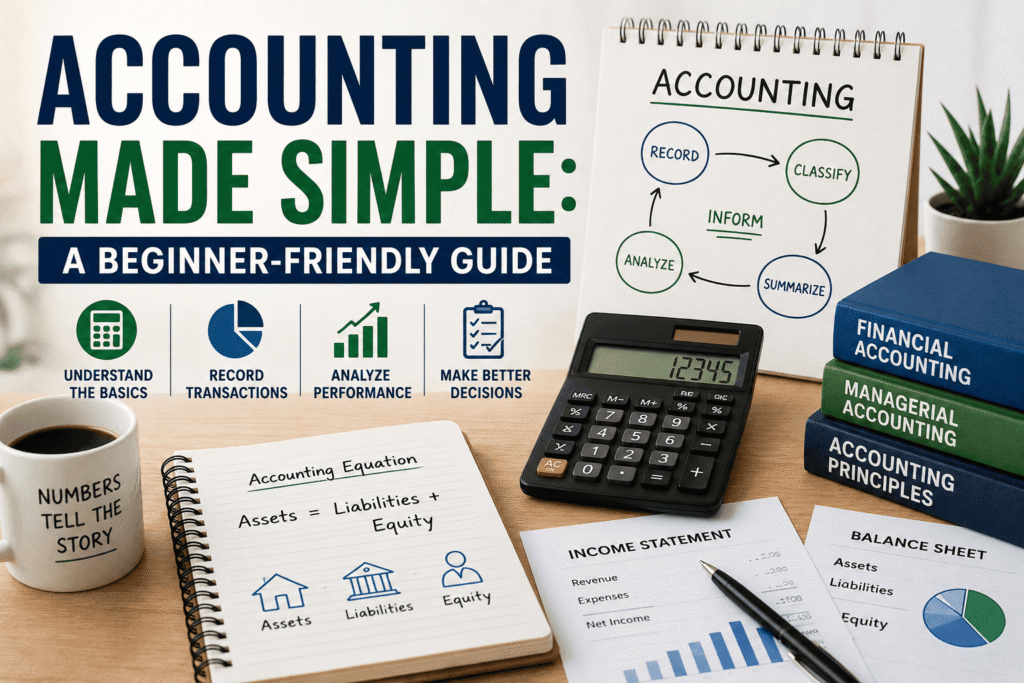
The Accounting Equation, Symbol by Symbol
| Assets | Resources the company controls: cash, inventory, receivables, equipment. |
| Liabilities | Obligations to others: payables, loans, taxes due. |
| Equity | Owners’ claim: capital invested + retained earnings. |
| Balance | The two sides must always be equal — every transaction affects both. |
Sample Balance Sheet (Position on One Date)
| Assets | $ | Liabilities + Equity | $ |
|---|---|---|---|
| Cash | 20,000 | Accounts payable | 15,000 |
| Inventory | 30,000 | Bank loan | 35,000 |
| Equipment | 50,000 | Equity | 50,000 |
| Total assets | 100,000 | Total L + E | 100,000 |
100,000 = 50,000 + 50,000 ✔ — the equation balances.
Sample Income Statement (Performance Over a Year)
| Revenue | 120,000 |
| − Cost of goods sold (COGS) | 70,000 |
| = Gross profit | 50,000 |
|---|---|
| − Operating expenses | 25,000 |
| = Operating profit (EBIT) | 25,000 |
| − Interest | 5,000 |
| = Profit before tax | 20,000 |
| − Tax (25%) | 5,000 |
| = Net income | 15,000 |
Cash Flow Statement: 3 Sections
Operating
Cash from the core business: customers paid, suppliers and salaries paid.
Investing
Buying or selling long-term assets like equipment or investments.
Financing
Borrowing, repaying loans, issuing shares, paying dividends.
Net change in cash = Operating + Investing + Financing.
How the 3 Statements Connect
- Net income from the income statement is the starting point of operating cash flow.
- Net income not paid out as dividends is added to retained earnings in equity on the balance sheet.
- The ending cash on the cash flow statement equals cash on the balance sheet.
Interview Questions
What are the three main financial statements?
The balance sheet (financial position at a date), the income statement (profit or loss over a period) and the cash flow statement (cash in and out over a period).
Why must the balance sheet balance?
Every asset is financed either by borrowing (liabilities) or by owners (equity), so total assets always equal liabilities plus equity.
Can a company have profit but negative cash flow?
Yes — for example if sales are on credit and customers haven’t paid yet, or if it bought a lot of inventory or equipment.
What is the difference between gross profit and net income?
Gross profit is revenue minus cost of goods sold. Net income is what remains after all expenses, interest and tax.
What is EBIT?
Earnings Before Interest and Taxes — operating profit from the core business.
Exam Quick Revision
- Assets = Liabilities + Equity.
- Balance sheet = position on a date.
- Income statement: Revenue → Gross profit → EBIT → Net income.
- Sample: revenue 120k → net income 15k.
- Cash flow: Operating, Investing, Financing.
- Net income → retained earnings; ending cash → balance sheet.
Course Path
- Lesson 1: What Is Finance? Finance vs Accounting vs Economics
- Lesson 2: Personal Finance: Budgeting and the 50/30/20 Rule
- Lesson 3: Time Value of Money: PV and FV
- Lesson 4: Compound Interest and the Rule of 72
- Lesson 5: Loan EMI and Annuities
- Lesson 6: Financial Statements Explained You are here
- Lesson 7: Financial Ratios with a Sample Company
- Lesson 8: Risk, Return, Diversification and CAPM
- Lesson 9: Capital Budgeting: NPV, IRR and Payback
- Lesson 10: Cost of Capital and WACC
- Lesson 11: Break-Even and Cost-Volume-Profit Analysis
- Lesson 12: Bond and Stock Valuation
- Lesson 13: Islamic Finance: Murabaha, Ijarah, Sukuk
- Lesson 14: What Is Fintech?
- Lesson 15: Finance Interview Questions and Formula Cheat Sheet